

Bank customers in India should be aware of a proposed nationwide bank strike at the end of September 2026. Bank unions have announced a three-day strike from September 28 to September 30, 2026, raising concerns over several issues related to employees and banking operations.
The announcement has created questions among customers about branch closures, cash withdrawals, cheque services and digital payments. If you have banking work planned during this period, knowing which services could be affected can help you avoid unnecessary delays.
Here is a look at the bank strike, the issues behind it and what customers can expect.
Table of Contents
Bank Strike 2026: When Will It Take Place?
The proposed bank strike is scheduled for September 28, 29 and 30, 2026.
The situation is slightly different from an ordinary three-day closure because September 26 and 27 are Saturday and Sunday. September 30 is also the half-yearly closing day for banks.
To reduce the possible impact on customers, the government has announced that Public Sector Banks and Regional Rural Banks will operate on Sunday, September 27. This arrangement is intended to provide an opportunity for customers to complete important banking work before the proposed strike.
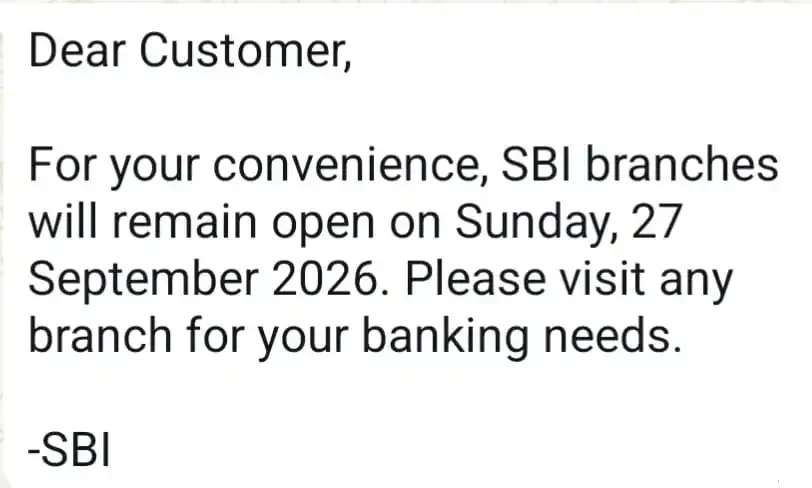
Customers should still check their own bank’s latest notice because arrangements can differ between institutions.
Why Are Bank Employees Planning the Strike?
The principal issue highlighted by bank unions is the demand for a five-day banking week.
Bank employee organisations have been seeking a system under which banks would remain closed on Saturdays and Sundays. Unions have argued that the five-day week proposal was included in the settlement reached between employee organisations and the Indian Banks’ Association, but its formal implementation is still pending.
The government has presented a different position on the matter. The Finance Ministry has said that there was no final commitment to introduce a five-day banking week and that the proposal remains under consideration.
This difference between the unions’ position and the government’s position is one of the reasons the issue remains unresolved.
Pension Is Another Major Concern
Pension-related matters are also among the issues raised by bank employee organisations.
Retired bank employees and unions have been seeking updates to pension benefits, along with changes concerning the calculation of Dearness Allowance for pensioners.
Another demand concerns employees covered by the National Pension System. Unions have sought an opportunity for eligible employees to move from NPS to the Old Pension Scheme.
These are long-standing issues, and their inclusion in union demands shows that the proposed strike is not limited to working hours alone.
What Is the Dispute Over Performance-Linked Incentives?
Performance Linked Incentive, commonly known as PLI, has also been part of the disagreement between bank unions and authorities.
Unions have raised objections to aspects of the incentive arrangement and have demanded changes.
There has, however, been a recent development on this matter. The Finance Ministry announced on September 21, 2026, that the PLI scheme had been kept in abeyance following discussions with representatives of bank unions.
As a result, PLI is no longer in exactly the same position it was when the latest strike call was announced. The five-day banking week remains a key unresolved issue highlighted by the unions.
Will Bank Branches Remain Closed?
If employees participate in the strike, customers can expect disruption at participating bank branches.
Services that normally require staff assistance may be unavailable or delayed. These can include:
- Cash deposits at branches
- Cash withdrawals from branches
- Cheque-related work
- Account service requests
- Submission of banking documents
- Loan-related paperwork
- Demand draft and similar branch services
Customers who have work that cannot be completed online should therefore avoid postponing it until the strike dates.
Can You Use ATMs During the Bank Strike?
ATMs are not dependent on normal branch opening hours, so they are expected to remain available during the strike.
However, an ATM can sometimes run out of cash, especially when many customers withdraw money at the same time. A machine may also become temporarily unavailable because of technical problems.
For essential cash requirements, customers may want to plan ahead rather than depending on a single ATM during the strike period.
Banks have also encouraged customers to use available self-service facilities where possible.
Will UPI Stop Working During the Strike?
A bank strike does not automatically mean that UPI payments will stop.
UPI is a digital payment system, and customers can normally use their banking apps and UPI applications without visiting a branch. Internet banking and mobile banking can also continue to be useful for many routine transactions.
That said, no digital payment system is completely immune to technical problems. A particular bank’s app, UPI service or payment infrastructure could experience an outage for reasons unrelated to the strike.
For an important payment, completing the transaction ahead of time can help avoid last-minute problems.
What About NEFT, RTGS and IMPS?
Customers may continue to use electronic fund transfer services through their bank’s digital channels.
NEFT, RTGS and IMPS are designed to support electronic money transfers without requiring customers to visit a branch for every transaction.
The availability of a particular service can depend on the bank and the payment channel being used. Therefore, customers making an urgent transfer should check the transaction status rather than assuming that every service will operate exactly as usual.
How Can Customers Prepare for the Strike?
A little planning can make the strike period much easier to manage.
If you need to visit a branch for documentation, cheque work or another offline service, try to finish it before September 28.
It is also worth checking your mobile banking and UPI access in advance. Make sure your registered mobile number is active and that you can receive OTPs when required.
If you expect to need cash, plan your withdrawal according to your actual requirements instead of making unnecessary large withdrawals.
Most importantly, keep an eye on your bank’s official communication. Banks may issue customer advisories with information about branch operations and alternative channels.
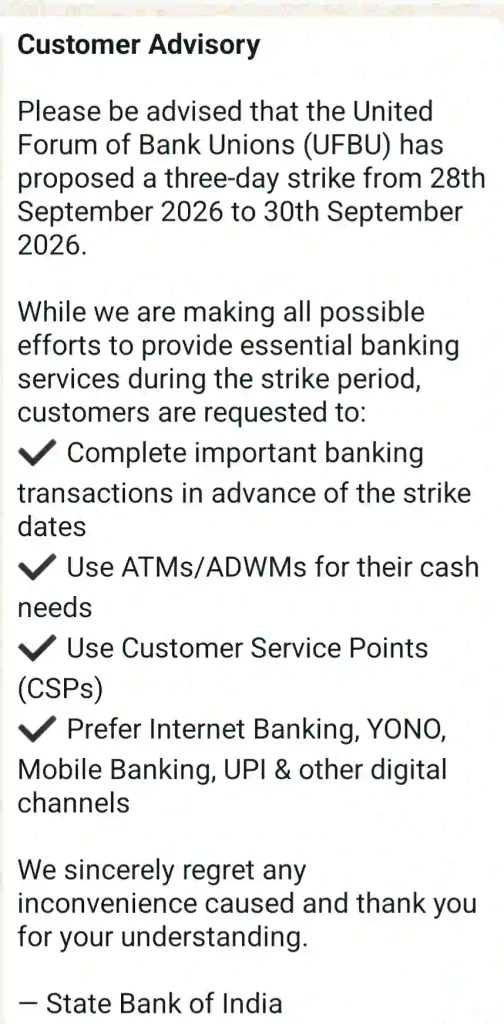
Customer Advisory: Check Your Bank’s Latest Notice Before the Strike
Will All Banks Be Closed?
No, customers should not assume that every bank in India will be closed throughout the strike.
The extent of disruption depends on employee participation and the type of bank. The strike is primarily expected to affect banks where the participating unions have a presence, particularly public sector banking operations.
Private sector banks may continue their regular branch services, although individual banks can issue their own advisories.
Checking the official website or customer communication of your bank is therefore the safest way to confirm its operating arrangements.
Final Takeaway
The Bank Strike 2026 scheduled for September 28 to 30 is centred largely on the demand for a five-day banking week, while pension-related matters and other employee concerns have also featured in the unions’ demands.
For ordinary customers, the biggest concern is likely to be access to physical bank branches. Digital options such as UPI, mobile banking, internet banking and electronic fund transfers can provide alternatives for many routine transactions.
If you have an important banking task that requires branch staff, completing it before the strike dates is the simplest way to avoid inconvenience. Customers should also check their bank’s latest official advisory because operational arrangements can change.
The government’s decision to keep certain public sector and regional rural bank branches operational on September 27 gives customers an additional opportunity to complete essential work before the proposed strike.